

Planting mangroves to defend communities
A mangrove restoration program in northern Mozambique aims to help protect the coastline from storms while supporting ocean ecosystems, too.
The Indian Ocean coastline of northern Mozambique is a sandy flatland where palm tree forests dominate the interior whilst near the shore, mangrove trees line the mouths of the blue sea. Despite being the poorest part of the country, it’s an idyllic land of beauty where the biggest human populations prefer to live near the ocean for the ease of trade and to forage seafood resources.
However, the region is facing significant effects from climate change, such as the super cyclone that hit the districts of Mecufi and Milamba in December 2024. Keeping land, livestock and vulnerable members of society from being swept away into the ocean hinges on wild plants: the mangrove in particular, says Josica Nada, a community leader and forestry activist in Mecufi. “We are not planting mangrove plants out of eco-green fashion, but survival,” he says of what he calls his community’s “heroics” in replanting a two-hectare coastal zone with mangrove plants in the past five years.
Injured forests
Mozambique is facing significant forest loss, not only inland but on the coasts too. From 2013 to 2023, mangrove cover was reduced by 18 percent, from 2,116 to 1,739 square kilometres. Slashing and burning for agricultural purposes and gathering firewood for heating and cooking are the major reasons why poor coastal communities don’t hesitate to mow down mangrove trees, says Henriques Bongece, the Mozambique secretary of state for sea, inland, wateries and fisheries. “This is because northern Mozambique is the poorest part of the country – whereas Mozambique is already Africa’s eighth-poorest nation,” he adds.
 Sugato Mukherjee
A grassroots solution
Now, a grassroots initiative – the Northern Mozambique Rural Resilience Project (NMRRP) – is taking shape in northern provinces. A key component of the NMRRP is the race to restore mangrove forest cover along the coastline ahead of the arrival of future megastorms.
The NMRRP, which began in 2021, is supported by the World Bank and aims to strengthen ecology management and slash poverty among vulnerable inhabitants of the region – with a key inclusion of youth and women. At the core, Bongece says, this is an attempt to recalibrate the entire World Bank footprint in Mozambique toward solving the core causes of climate disasters, deepening poverty and violent localized armed conflicts in places like the north.
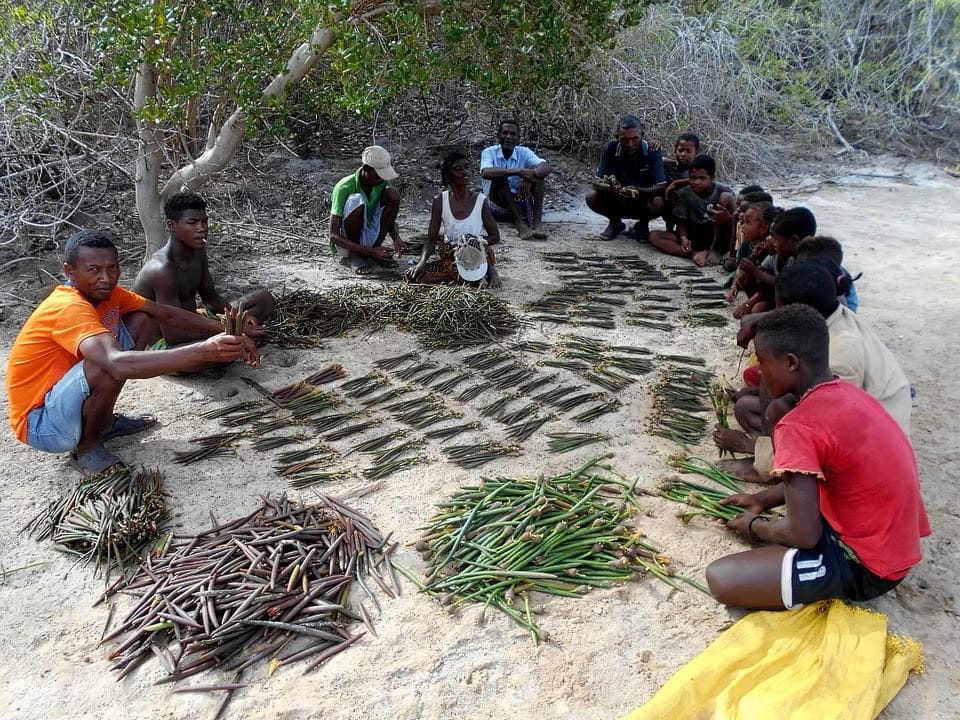
One way of doing this is mangrove shrub restoration and sustainable agriculture. The key focus of the mangrove project is having the community, not government bureaucrats or NGO experts, driving the program, says Bongece.
“I’m taking part because healthy mangrove forests protect my home, children, livestock from the rage of the ocean in times of extreme weather disasters,” Nada says of his role as the deputy community coordinator leading three villages in Mecufi through the program. “I am both a past culprit and a solution-maker. I was a former poacher – slashing down mangrove trees to expand agricultural land and sell to cooks. Now I am protecting the plants,” he adds proudly.
Mangroves are critically important in poor coastal locations where expensive iron or concrete anti-storm buffers cannot be erected. In such situations, they are the only organic barrier stopping the velocity and brutal force of climate storms, says Shamiso Mupara, an environment management technician and regional reforestry activist who has had exchange trips to Mozambique’s coastal cities like Beira in the past.
 Ray Mwareya
A holistic approach
Instead of simply manually replanting mangrove trees, communities in Mecufi led by Nada dream of an encompassing goal of “hydrological restoration,” he says. “We move beyond poking seeds in the mud to re-engineering the land: digging strategic channels so that tides do the heavy lifting, transporting natural seeds into erased forest zones to kickstart a forest.”
The villages that he works with are organized under local so-called Mangrove Nursery Associations, which are essentially made of mums, the elderly or youths, street traders, artisanal fishermen and livestock shepherds who fancy themselves as “defenders against the tide of water,” he adds.
“The mangroves are precious for us too as fishermen,” says Amos Machado, a Mecufi restoration participant who says that without the mangroves, the nursery areas where they catch fish and other seafood species would die. “It’s all linked, hence I am doing this without expecting any payment,” he says.
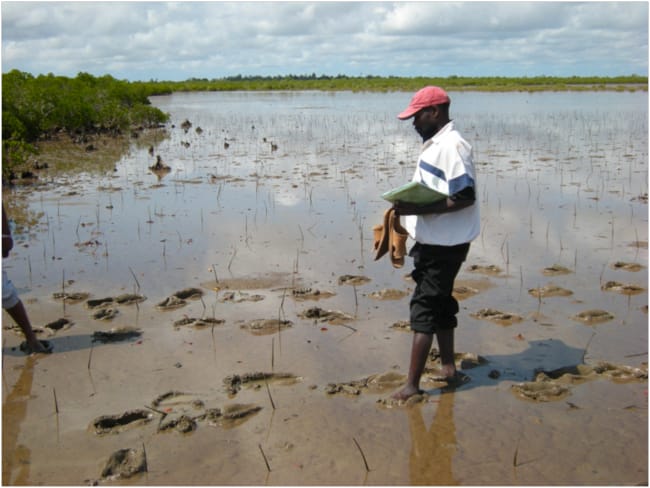
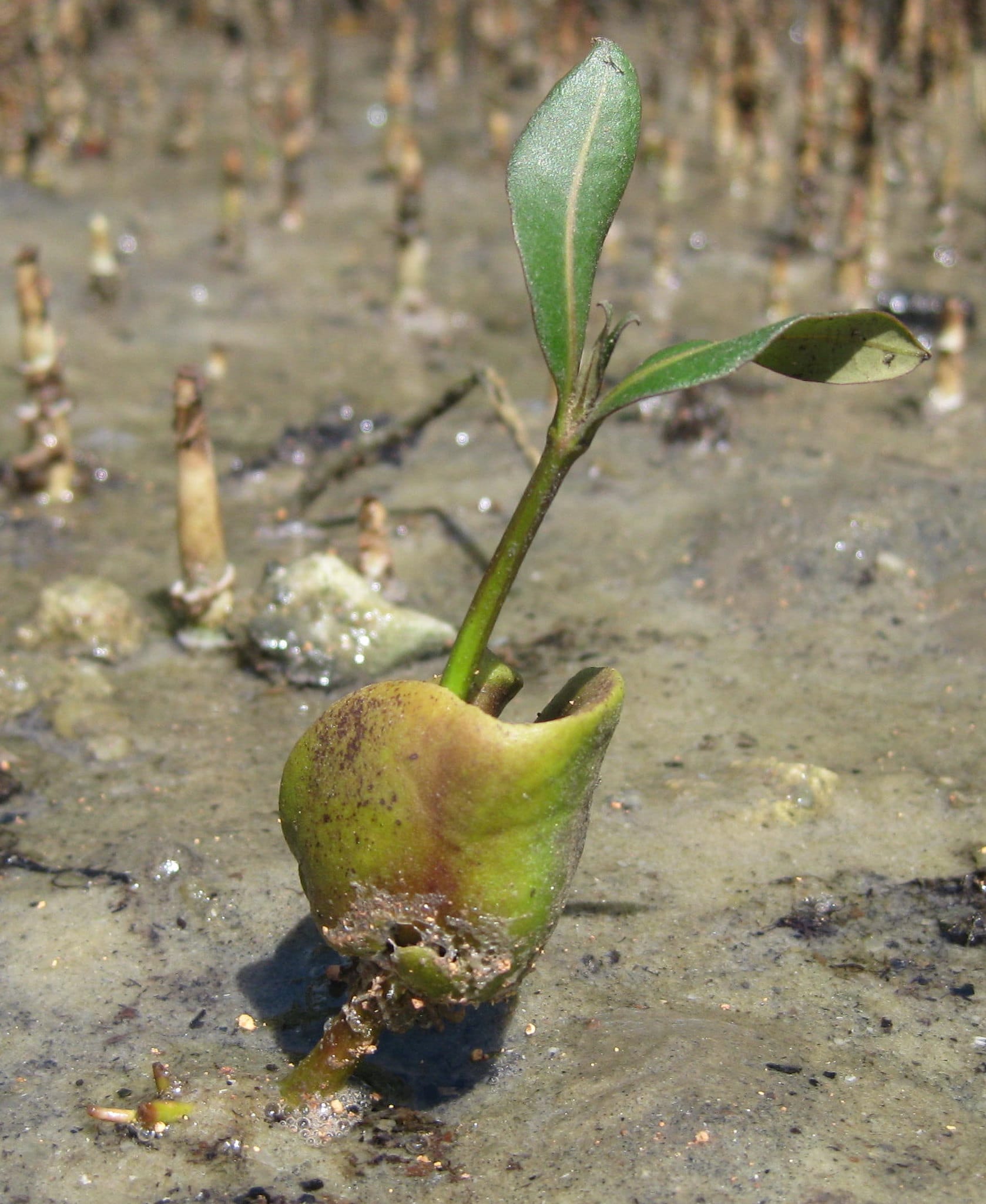
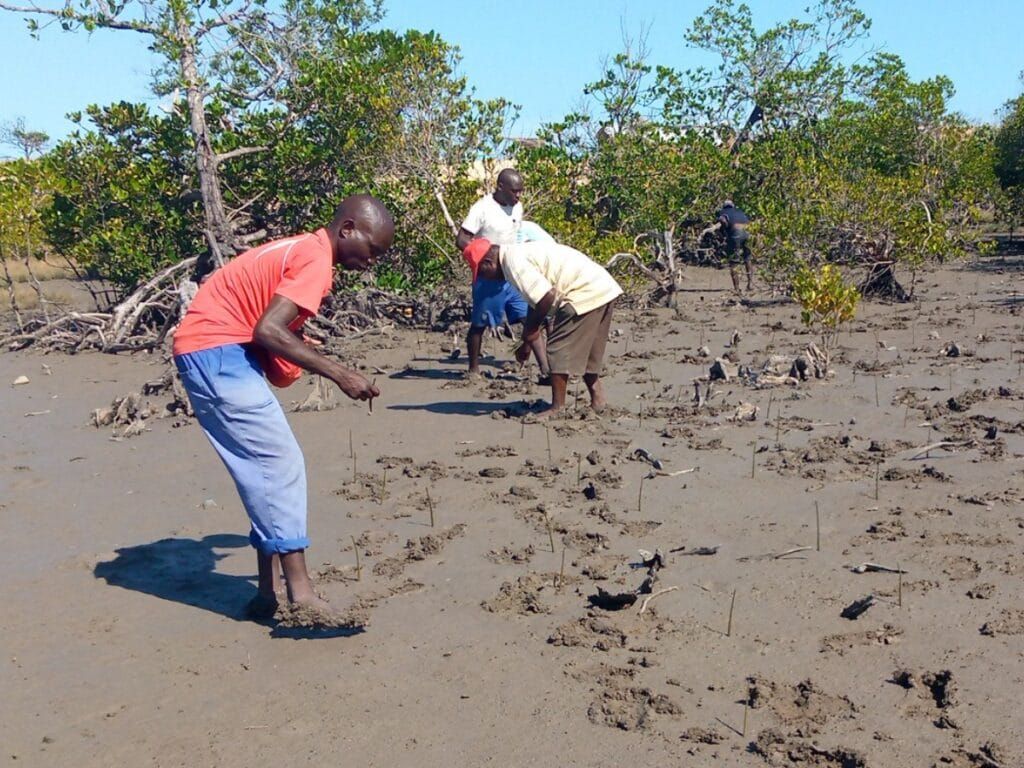
Left: Planting mangroves. Photo courtesy Bruce Myers Consulting. Right: A white mangrove (Avicennia marina} seedling on Pemba bay in northern Mozambique. Photo: Ton Rulkens/Flickr.
A growing impact
The results of mangrove restoration have been brilliant for local fishermen, says Machado. And Bongece points out that mangrove forests are sprouting again, with nearly 40 hectares of mangrove plants restored in the region. Though generally mangrove trees take between five years and a decade to mature, some are relatively fast growing, especially near warm coastal waters. Some red mangrove tree species have matured to four feet high in a year, Bongece reveals. “For those growing slowly we can see that the seeds (propagules) are already germinating whilst attached to the root tree,” he says. “This means they are already miniature, living, thriving plants when they drop from the parent tree.”
Artisanal foresters say they have seen the gradual benefits with the fast-growing species. Such quicker-growing mangroves are becoming breeding grounds for crayfish, crabs and snails, which fishermen catch for food and trade. “The quicker-growing mangroves are colonizing more inland estuaries, and shallow waters, where we can access more seafood species easier,” confirms Machado. “The catch of the day is getting easier – we don’t have to extend our nets to riskier offshore depths of the ocean because the sprouting mangrove shrubs attract more seafood species toward the shoreline.”
The mangrove restoration is not just fashionable “environmentalism,” agrees Nada. It’s food security and safety against terrific climate storms.
For Bongece, the environmental bureaucrat, the immediate plan is to expand the mangrove restoration to 60 hectares in the next two years, and to establish a small stipend – funding-dependent, of course – whereby local fishermen can dedicate at least a day of their workweek to plant and monitor mangroves. “We believe the very small stipends of something like $5 per person a week can spark motivation for more fishermen to become planters of mangrove plants,” he says. “Fishermen are one of the main actors behind the destruction of mangroves, so we want to turn them into solution-makers.”




Comments ()